Part of: Paying in Vietnam
The heat sets your schedule in Saigon, and honestly it’s a good boss. Mornings are cool enough for real work. By two o’clock you want air conditioning, an iced coffee, and calls you can take sitting still. The fiber is fast, the coffee is serious, and a good working day costs so little you stop counting.

Desks are everywhere. The skill is matching the room to the task.
Where the work gets done
Let the cafés be your office
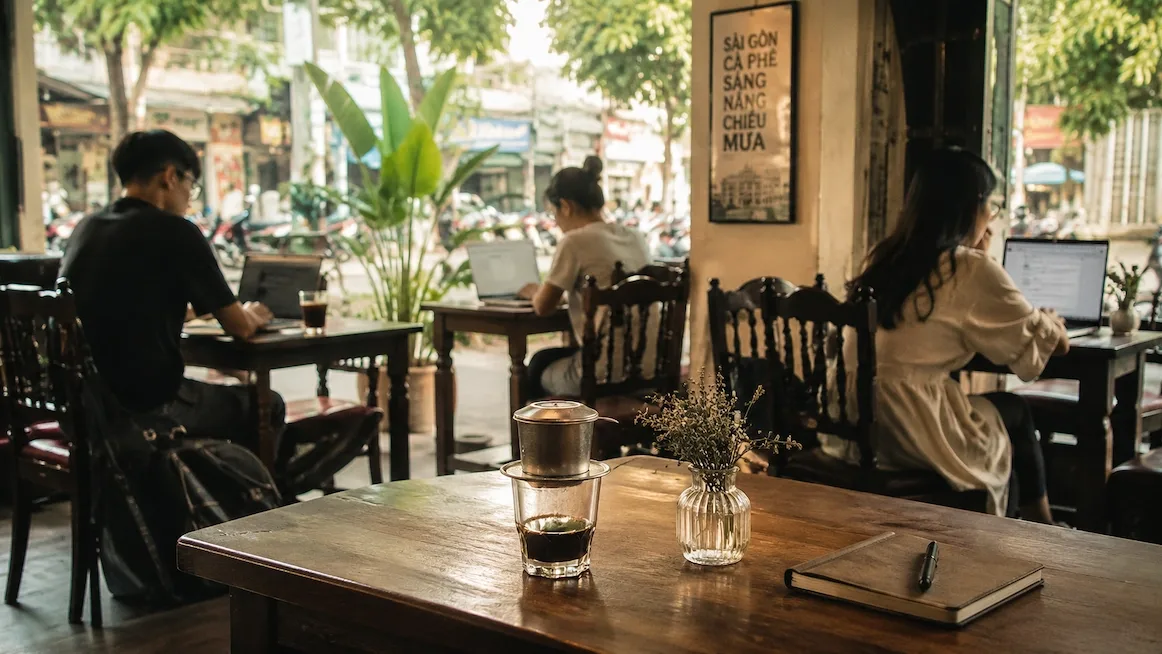
Saigon runs on coffee, and the café scene is built for lingering. Order a cà phê sữa đá, find a seat, and nobody hurries you. Thao Dien and District 3 are thick with quiet, air-conditioned rooms, and the local chains have fast wifi and plenty of plugs. It's the cheapest, most pleasant desk you'll find most days of the week.
Book coworking for the calls
When you need silence and a stable line, Dreamplex, Toong and The Hive keep well-run spaces across District 1 and beyond, with day passes and monthly desks. Thao Dien has its own options if you're basing there. Book a day when a client call cannot drop; the café stays your default the rest of the week.
Work with the clock, not against it
Vietnam sits at GMT+7, a gift if your team is in Asia or Europe and a discipline if they're in the States. European mornings land in your afternoon; American teams mean early starts or late nights. Most nomads front-load deep work before lunch and keep the humid afternoons for calls, errands, and the pool.

Order the cà phê sữa đá, open the laptop, and the afternoon is yours.
Mistakes to avoid
Trusting café wifi for the call that matters
Central-district fiber is quick, but a busy café is still a gamble on the line. Book a desk at Dreamplex, Toong or The Hive when a client call can't drop.
Fighting the afternoon heat
By two o'clock you want air conditioning and an iced coffee, not a productivity crusade. Front-load the deep work into the cool morning and keep the humid afternoons for calls, errands and the pool.
Expecting a comfortable US overlap
Vietnam runs GMT+7 with no daylight saving, and American teams feel every hour of it. US hours mean early starts or late nights on your side, so set the expectation and lean on async habits.
Skipping the backup line
The fiber is good, but keep an eSIM with a solid data plan as your fallback. When the work is mission-critical, take a coworking day over a crowded room.
Common questions
Is the wifi reliable?
For city work, yes. Vietnam has invested heavily in fiber, and café and coworking wifi in the central districts is quick. Keep a backup though: an eSIM with a solid data plan lets you hotspot through a wobble. For anything mission-critical, a coworking day beats a busy café.
Best neighborhoods to work from?
District 1 and District 3 for the central café-and-coworking density, and Thao Dien across the river if you want quiet, air-conditioned rooms and western comforts. Binh Thanh sits in between for value. All four have fast fiber and plenty of cafés happy to host you all day; the choice is really whether you want the buzz of the center or the calm of the expat side.
What's the timezone overlap with the US?
Slim, honestly. Vietnam runs GMT+7 with no daylight saving, which suits Europe well (their morning is your afternoon) and asks real discipline of US teams: overlap means early starts or late nights on your side. Most nomads do their deep work before lunch, push calls and errands into the humid afternoon, and let async habits cover the rest.
Will a café let me sit and work?
Gladly. Cafés here expect you to stay: one cà phê sữa đá buys a seat nobody asks you to give up, even three hours in. Wifi is fast at the local chains, plugs are everywhere, and District 3 and Thao Dien have the pick of the quiet, air-conditioned rooms. When a call absolutely has to hold, that's what a coworking desk is for.